Years after Citizens Bank sold and eventually became part of U.S. Bank, the historic building on Fourth and Broadway, where it had operated for generations, went up for sale. Bill Jones, who had led Citizens Bank in its final years, realized one story wasn’t over. Six oil portraits had hung in the boardroom for decades—the faces of the men who had led the bank before him. He knew what usually happens to portraits nobody remembers commissioning: a dumpster, or if they’re lucky, a forgotten corner of a warehouse. So, he made a call, got permission from someone still working there, and brought the six men home.
His wife, Theresa, took one look at the row of paintings leaning against their living room wall and asked the obvious question: what exactly were they going to do with these?
Jones didn’t know yet, but he wasn’t going to let them disappear twice. He set out to uncover their stories and reconnect the portraits with the families they belonged to. Along the way, he pieced together the lives that had shaped Citizens Bank—and Paducah—for more than a century. That effort became Seven Visions, One Legacy, his book on the presidents of Citizens Bank and Trust Company.
Caroline Barr didn’t know the portraits existed until Bill Jones called her out of the blue, connected through a mutual friend who happened to know the Rudy family. Two of the six men in the boardroom were hers: her great-grandfather James Augustus Rudy, the bank’s first president, and her great-uncle Richard Rudy, its third. She and her brother each received a striking portrait, two feet tall, hers with a small brass plaque noting the years Richard Rudy served—1920 to 1933.
Reading Seven Visions, One Legacy, Barr felt like she was meeting her own ancestors for the first time. To her, James Augustus Rudy had always been the family name behind Rudy’s Department Store, the downtown landmark once known as “the Macy’s of the South.” Jones’ research introduced her to the young man who had headed west in search of gold before returning to Paducah to build one of the city’s most beloved businesses. She also discovered that Richard Rudy had secured the land that became Noble Park, championed the construction of the Brookport Bridge, and married Rubie Cobb, sister of famed author Irvin S. Cobb, after a decades-long courtship, though the marriage itself lasted only a year before his death.
What struck Barr most was that Jones had bothered to chase them down at all. “It would be very easy just to close the door on that and say, I don’t care,” she related. She called him, without hesitation, a Southern gentleman from a bygone era.
It’s a fitting description, and not just for Bill. Reading these men’s stories, a pattern starts to emerge—one of civic work that shaped the Paducah we enjoy today, a bank steered through difficult times over decades, and a habit of chivalry. Different centuries, same instinct: do the right thing and let it stand on its own, whether or not anyone happens to be watching.
Citizens Bank was founded in 1888 with $50,000 in capital. It survived the Great Depression while nearly every other bank in the region closed, and eventually sold in 1998 for $285 million. Yet by the time Jones had finished the research, he found himself thinking less about balance sheets and more about stewardship—sitting with six painted faces and understanding, finally, what each had contributed to something larger than himself.
Ann Nagel knows something about that kind of devotion. Her father, Fred Nagel, led the bank for 21 years. Stories about him tend to circle back to a familiar theme: he did the right thing and rarely let anyone know he’d done it. Larger banks from bigger cities tried more than once to recruit him away, but he stayed, out of loyalty to Paducah and his family. He helped raise the money to expand Baptist Hospital, a project many in town doubted could be funded at all. He discreetly made personal loans from his own pocket when the bank couldn’t. Every Halloween, while his daughters trick-or-treated through the neighborhood, Fred Nagel was still at the bank balancing the month’s books by hand. The girls would end the holiday the same way every year: costumes on, knocking on the teller windows so their father could hand them candy before going back to work. “That’s my daddy,” Ann said. “Plain and simple.”
But Ann insists it wasn’t only her father. “All those men,” Ann said, thinking back on the whole line of Citizens Bank presidents. “They were all like that.”
Long before Bill Jones ever came looking for her, Ann had already gone looking for her father’s portrait herself. Decades earlier she glimpsed it in the window of a shuttered building next to the old bank while driving down Broadway. She inquired into the portrait, leaving her name and number. She never heard back, and eventually let it go. Thirty years later, the phone rang—it was Bill Jones.
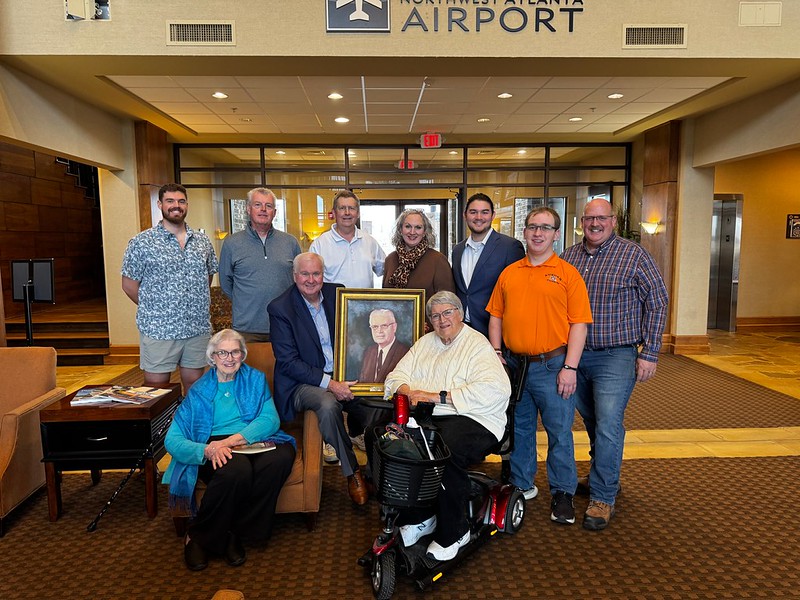
He didn’t offer to ship it. He said he’d fly it to her personally. By the time the plane landed at the small Georgia airport near her home, nine family members were waiting—daughters, grandchildren, great-grandchildren, some driving over a hundred miles and taking the day off work. All for a portrait many of them had never seen and had assumed was gone for good. Jones recalls his mouth fell open as he walked in and saw them all standing there. “This is a big deal,” Ann told him. “We’re really excited about it.” And they were.
Ann wanted to make sure Bill knew how much this had meant to the families. “I don’t know if you realize how special you are and how much you actually mean to so many people for doing this,” she’d told him. “This book is just a gem for people who had anything at all to do with that bank.”
Jones, the seventh and final president, never had his own portrait painted. When I suggested that perhaps the book had become his portrait, he smiled. “The book IS my portrait.” His son Chris told him once that he’d always known what his father’s job was. He just hadn’t understood what he did—not until he read the book.
For those who’d like to spend more time with the stories behind the portraits, Seven Visions, One Legacy is available through Amazon.