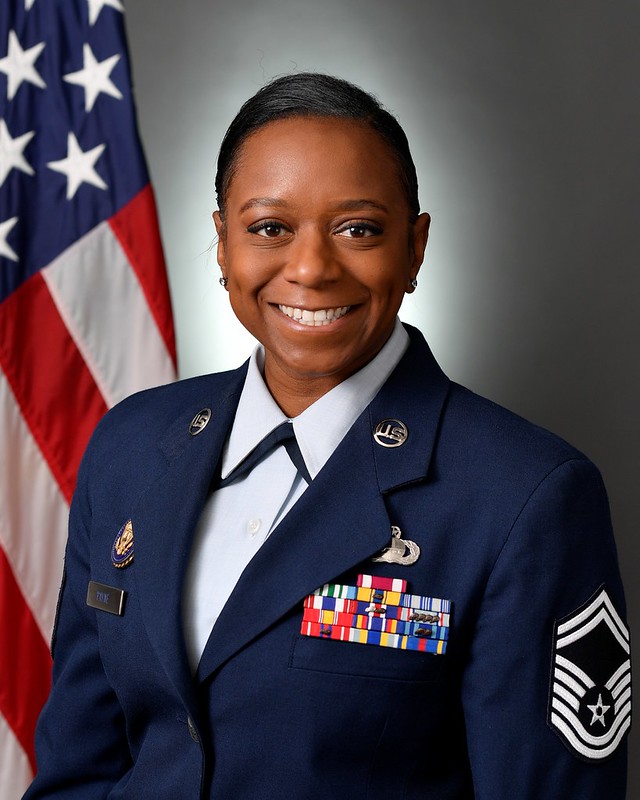
When U.S. Air Force Senior Master Sergeant Samantha Payne walks into a room, people notice—not just because of the rank on her uniform, but because of the unmistakable Kentucky warmth in her voice. She doesn’t soften her accent or downplay her roots. In fact, she leans into them.
“I’m just me,” Payne says with a laugh. “I’m this little girl from Paducah, Kentucky, who happens to speak Chinese fluently, work in national security, and still sounds like home.”
Home, for Payne, will always be Paducah. A 1998 graduate of Paducah Tilghman High School, Payne never imagined that what began as a four-year plan would become a nearly two-decade career in the U.S. Air Force—one that has taken her from the Defense Language Institute in Monterey, California, to the Pentagon, the White House, Capitol Hill, and across the globe.
After high school, Payne attended Western Kentucky University before transferring to the University of Evansville, earning a degree in education. She moved to Atlanta to teach, a job she loved—but love did not pay the bills. “I was hungry,” she said. “I enjoyed teaching, but I couldn’t live on the salary. I knew I needed another path—one that would pay for my education.”
That path was the U.S. Air Force. At 26—older than many recruits—Payne joined with the intention of serving four years and earning a master’s degree in a medical related field. Instead, she took a battery of aptitude tests and was selected for one of the most demanding roles in the military: a cyber-Chinese language analyst. She learned Mandarin at an intense pace, studying long days until she could understand Chinese news broadcasts within a year.
For 13 years, Payne worked on classified cyber and intelligence missions, supporting national security efforts. Her expertise led her to leadership roles at the Air Force Institute’s Chinese Aerospace Studies Institute—where she found joy returning to her teaching roots—and eventually to assignments few service members ever experience.
Payne has served in the Pentagon, the office of the Chairman of the Joint Chiefs of Staff, and the White House, where she worked on the National Security Council as a policy advisor for emerging technologies. There, she helped write global policy on artificial intelligence, quantum technologies, and biotechnology, crafting talking points for the Vice President, President, and National Security Advisor, and helping organize the world’s first global AI summit in the United Kingdom. She completed a congressional fellowship and worked in the office of U.S. Representative Marc Veasey of Texas on defense, public health, veterans’ issues, cyber policy, and foreign affairs.
Today, she serves as a Department of the Air Force Congressional Liaison, accompanying members of Congress around the world, coordinating travel, and ensuring national security and military priorities are met on the ground.
“I’ve seen policy from every angle—executive, legislative, and now military,” Payne says. “It all connects.”
Payne’s rise through the ranks has not come without adversity. While learning Chinese early in her career, she was struck by a vehicle during a training exercise, leaving her with chronic pain and nerve damage. Despite this injury and the physical demands of the military, she has continued to serve.
She is also a survivor of military sexual trauma, an experience that reshaped not only her life, but her mission. In 2017, while stationed in Hawaii, Payne reported sexual trauma by another service member. Instead of retreating, she became a victim advocate for nearly a decade, completed her internship with the Air Force sexual assault office, and earned a Master of Public Health, writing her thesis on military sexual trauma. Her advocacy reached Congress and contributed to meaningful changes within the Air Force and Department of Defense, including stronger accountability for sexual harassment.
During this work, she also wrote a book, Tamar’s Voice, inspired by the biblical story of Tamar, giving voice to survivors of sexual violence and reframing silence as strength reclaimed.
“The journey has stretched me in ways I never expected,” Payne says. “As a Black woman in the Air Force, I’ve had to learn when to speak and when to prepare. But everything I’ve been through has sharpened my purpose.”
In August 2022, Payne graduated from the Air Force Senior Noncommissioned Officer Academy as a distinguished graduate, serving as class leader for hundreds of peers. She also won the Etchberger Team Award, an especially meaningful honor, as it was her instructor’s final class before retirement. She earned the Brigadier General Wilma Vaught Visionary Leadership Award at the Air Force level, recognized among competitors across the service for her leadership and innovation. Now an E-8 Senior Master Sergeant, Payne has one rank left to achieve and plans to serve approximately 25 years.
“The Air Force and I are clearly not done with each other yet,” she says. “I’ll be finishing strong, serving with purpose, and investing in the next generation of Airmen.”
Despite living at Joint Base Anacostia-Bolling in Washington, D.C., Payne will always stay connected to Paducah. Her father and stepmother still live here, and her family’s influence—from her aunt Donna Hawkins, a retired Paducah educator and now a minister, and Uncle Henderson, the chaplain at Baptist Health hospital, to her involvement in Delta Sigma Theta Sorority, Inc.—continues to shape her commitment to education, service, and mentorship. She proudly carries Paducah with her wherever she goes.
“When I teach or brief on China or strategic competition, I do it with Kentucky flair,” she says. “I don’t hide my accent. People say I’m hospitable—and that’s Paducah.”
Payne is also a mother to 13-year-old Aniyah, an artistic, NASA-dreaming teen who has already met female astronauts and imagines her own future among the stars. Payne is engaged to Kenneth Powell, who she met last Valentine’s Day, with plans to marry in Las Vegas in 2026.
And even now after the White House, Capitol Hill, and global summits, Payne remains grounded in faith, purpose, and possibility. “When I found out I had three more years left, I did not think I wanted to continue to serve,” she admits. “But I grew up in the church and I’m very spiritual. I know that God is telling me we have more to do here.”
“When I was five years old, I said I wanted to work at the Capitol and the White House, standing on the couch pretending to talk to audiences,” she says. “And it happened. I want people from Paducah—especially young Black girls—to know that where you start does not limit where you can go.”
From Paducah to D.C., Samantha Payne’s story reminds us that our roots are the foundation that carry us forward.