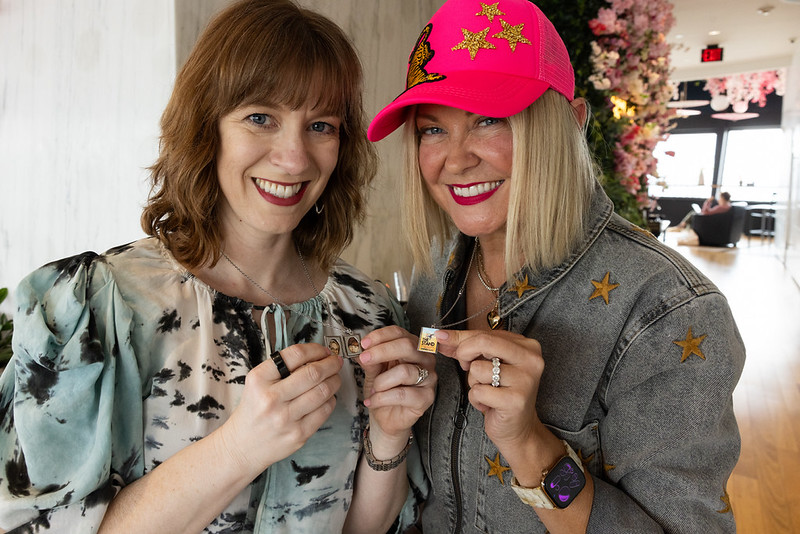
Fist resting under her chin, Sarah Stewart Holland takes a step back from the wall of books and assumes an I’m thinking stance. She looks up and down the stacks, scanning classics, biographies, fantasies, then steps forward and points a finger at the top right corner. “This one, this one, and this one,” she begins, gesturing at books from left to right. Works by Stephen King, Emily Henry, Anne Patchett, and more rest under her gaze.
The sound of coffee beans grinding hits before the scent wafts closely behind. “I’ve read this one, too. Not that one, but I heard it was great, so I had to have it. I’ve read this author before but not this title. Do you want me to keep going?”
She could—and she would—because that’s the thing about people who love books and are standing in a perfectly curated bookshop, but her thoughts are snagged on an out-of-place tome. It’s obvious that Meander, a small but eager independent bookstore tucked in the heart of Pipers Tea and Coffee, is a physical manifestation of joie de livre—the joy of books.
“Everybody wants to own a bookstore, right?” Holland laughs. But as the daughter of a librarian, bookstore ownership was more of a fait accompli than a matter of opportunity.
A patron approaches and she and Holland have an ordinary little bookstore moment, which in 2026 is probably more extraordinary given the fact that readers don’t even have to go into a bookstore to find a book. A few simple taps and voila, a library in your pocket. So, why open a bookstore?
“You can get any book on planet earth delivered,” she says. “That sounds like heaven in a way, but I think we’ve all learned that it’s overwhelming.” The promise of a bookstore, she says, isn’t that it has every book—it’s that it doesn’t. A bookstore’s options are immediately limited by the physical space, but especially with Meander, they’re limited even further by curation. “Either I’ve read it, or someone I know and trust has read it and recommended it,” she explains.
While the internet offers access, Meander puts a book in your hands and whispers, trust us, this is a good one. What makes a human recommendation so meaningful for readers? Holland says it’s less about walking away with a list of next-up books and more about being seen by someone who gets it. “I think people really like coming in and talking to a person,” Holland says. “I love the concept of people-picked books. When everything is personalized for us by algorithms, it sort of deafens that ability for a book to find you through fate.”
That phrase—a book finding you through fate—gets at something central to the Meander experience. A reader can search for the exact book she wants, or she could walk into a room full of books and let one catch her attention. One is an experience founded on filling a category while the other leaves room for meandering into a discovery.
Amber Barnett, co-owner of Pipers Tea and Coffee with her husband, Peter, sees the same distinction in the way Meander fits into Pipers. “Her level of curation and dedication to her craft very much translates to what we do,” Barnett says. “We have that same dedication and curation, so that just naturally fits.”
For Holland, the bookshop is another iteration of a career around starting conversations. For much of her adult life, she’s been building spaces where people discuss ideas despite differences. Long before Meander, there was Pantsuit Politics, the podcast she co-hosts with Beth Silvers, where the two talk through politics and culture with an emphasis on listening. In many ways, Meander is a manifestation of that same instinct, but now the conversation begins with a book jacket.
Her mission continues to bring people together around something worth talking about and see what happens next. Which, as it turns out, is something Paducah already knows how to do. Libraries, coffee shops, festivals, art, civic organizations, and burgeoning book clubs all create an existing culture of gathering. The thought isn’t that Paducah needs community, it’s that Paducah already has an affinity for gathering, and Meander is another expression of it.
Barnett and her husband have always thought of the coffee shop as a kind of space where people can slow down enough to actually notice where they are. “Who doesn’t love sitting with a cup of coffee or tea and a book?” Barnett says. As any book lover knows, coffee shops and bookstores just mesh because neither one is pushing an agenda. Chat with a barista, order a latte “for here,” pick up a book and read a few pages while forgetting the incessant need to accomplish something.
That kind of interaction lies at the heart of Meander. “I liked the name because it had multiple meanings,” Holland says. “I wanted a river term, and rivers meander along the shore. People can meander. I definitely think that’s how most people interact with a bookstore. They just kind of come in and let it talk to them.”
Holland believes reading matters because it gets us outside the limits of our own experience. “You can’t be limited to your own life experience,” she says. “It does not make you wise, it does not make you empathetic. You have to step into someone else’s shoes.” To read deeply is to experience someone else’s trials and triumphs. It asks you to stay with another person’s story long enough to understand the world from somewhere other than your own vantage point.
Meander fits, literally and metaphorically, inside of Pipers because the two are pushing forward a parallel mission of bringing people together, Barnett explains. “It’s just trying to facilitate that and bring people together from different walks of life and hopefully to encourage discourse,” she says. “And I think we need that more than ever.”
Holland wants Meander to make room for another kind of reader, too, the person who doesn’t think they’re a reader at all. She hears people apologize all the time. “I don’t read as much as I should.” “I haven’t read since high school.” “I listen to audiobooks, and I know that’s not as good.”
“Everybody just let that go, man,” Holland says, because she believes there is no correct way to be a reader. “I truly believe if we can let go of our preconceptions, anybody can become a reader. I think that path is available, and I hope that there’s a book in Meander that can turn anybody into a reader.”
Eventually, Holland steps away from the wall of books. She sees a reader just outside the room of books scanning the new releases table and walks up, placing a hand on the woman’s shoulder. “What are you looking for today?” Holland asks, smiling. The woman apologizes, saying, “Oh, I love to read, but I just can’t find the time these days.”
For bookseller Sarah Stewart Holland, there could hardly have been a better invitation. She leads the woman into the small room of books, saying, “When I don’t have much time to read, here’s exactly what I do,” her voice trailing off down the hallway as the two “meander” into the bookshop.


